
Pants are the most overlooked piece of riding gear. The jacket is chosen carefully, the helmet too, but pants are usually last. The problem is that the legs are the area that makes the most contact with the asphalt in a crash: knees, hips, thighs. Without protection, the consequences are serious.
This guide explains what types of motorcycle pants exist, what materials actually protect, what CE class A and AA certification means, and how to choose the right model for your use.
See all models: men’s motorcycle pants · women’s motorcycle pants
Types of Motorcycle Pants
Before looking at protection, choose the type based on how you use your bike.
Motorcycle Jeans
The most popular type for urban and daily use. They look like regular jeans but have aramid fiber on the inside (reinforcement in panels or woven into the denim) and CE protection at the knees and hips. Get off the bike and no one notices you’re wearing riding gear. They’re the most versatile option for riders who don’t want to carry technical clothing around.
Textile Pants (Cordura)
For touring, travel, and mixed road-city use. Made from technical fabric—cordura, polyamide, or similar—with greater abrasion resistance than denim, compartments for protection, and in many models, a waterproof membrane and removable thermal liner. Less discreet than jeans but more versatile for varying weather conditions.
Motorcycle Cargo Pants
A variant between jeans and textile. They have cargo-style side pockets, technical fabric or aramid-reinforced denim, and CE protection. A practical option for those looking for comfort and functionality without the look of technical pants.
Leather Pants
They offer the highest abrasion resistance in absolute terms, but weigh more, don’t breathe, and are mainly used for sport riding or track use. For daily urban use they’re not the usual choice.
Materials: What Protects and How
Aramid
Aramid—best-known trade name: Kevlar—is the fiber that turns regular jeans into motorcycle clothing. It resists abrasion where conventional denim would be destroyed in less than a second. It can be in interior panels in critical areas, or woven directly into the denim (single-layer technology), which is the most advanced system. If you want to understand the difference between the two in detail and see which Invictus models use each technology, we explain it in the aramid motorcycle jeans guide.
Cordura and Technical Fabrics
Cordura is a high-tenacity polyamide fabric used in textile pants. It’s more abrasion-resistant than conventional denim and holds up better in weather conditions. Textile pants usually combine an outer cordura layer with aramid panels or lining in impact zones.
Leather
Cowhide or buffalo leather offers the best slide abrasion resistance. Leather pants are designed for sport use and high performance. For everyday city use they don’t offer practical advantages over aramid jeans.
CE Certification: What Class A and AA Mean
Since 2021, the European regulation governing motorcycle clothing is EN 17092:2020, which replaces the previous EN 13595. All pants sold in the EU as motorcycle gear must be certified under this standard. There are three classes you’ll see on the market:
- Class A (EN 17092-4): basic protection. Passes the abrasion test simulating a crash at 45 km/h. Recommended for urban use and moderate speeds.
- Class AA (EN 17092-3): intermediate-high protection. Passes the test at 70 km/h for 2 seconds. The choice for mixed urban-road use. It’s the standard most brands use for their main range.
- Class AAA (EN 17092-2): maximum protection, designed for track and high speed. Test at 120 km/h for 4 seconds. Less common in daily use due to fabric weight and stiffness.
The class appears on the inside label of the pants along with the CE marking and motorcyclist pictogram. If that label doesn’t appear, the pants are not approved as motorcycle PPE, regardless of what the manufacturer says in the description.
In addition to the fabric class, look for CE EN 1621-1 protection for knees and hips. They can be level 1 or level 2. Level 2 absorbs more impact; if you ride a lot on the road, it’s worth it.
What Protection Should Motorcycle Pants Have
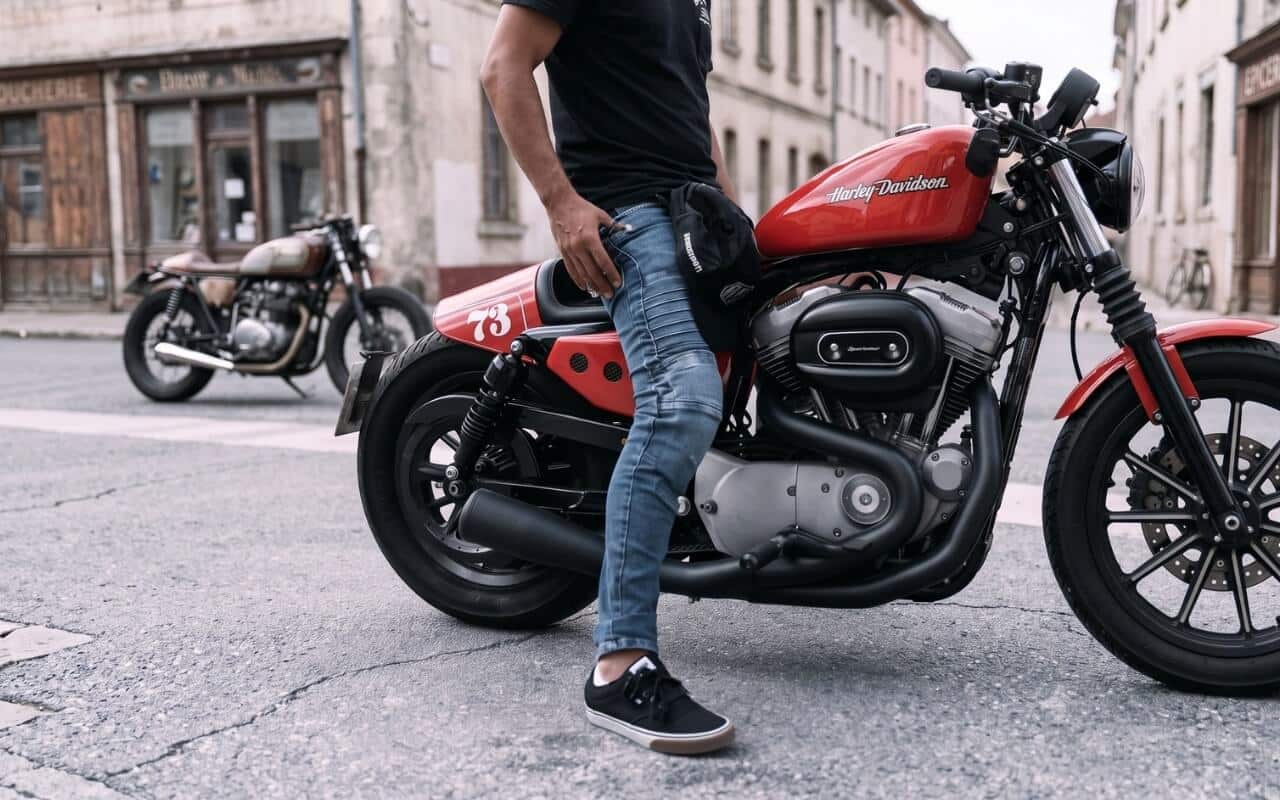
Class AA certified pants come with protection included at the knees and hips. But there are details that make a difference:
- Removable protection: lets you wash them like regular pants by removing the inserts. You can also replace them with level 2 protection if you want more protection without changing pants.
- External access: some models let you remove and insert protection without taking off the pants. Very practical for daily use.
- Adjustable position: the knee protector must sit right over the kneecap. Pants with a fixed knee protector that doesn’t fit your anatomy won’t protect where it needs to.
Based on Your Use, This Is Your Pant
Urban use, daily commute: aramid motorcycle jeans with class A or AA certification are sufficient and most comfortable. Get off the bike and go to work without changing. If you want to put together a complete gear setup—pants, jacket, and gloves—without going over budget, we explain it in the complete motorcycle gear for under €300 guide.
Mixed city-road use: class AA minimum. If you mix urban routes with weekend getaways, a waterproof model or one with a membrane saves you from carrying extra rain gear. Complete the gear with CE certified gloves from €39.95.
Touring and long trips: textile pants with waterproof membrane, removable thermal liner, and class AA or AAA. The weight and comfort on long rides justify a specific model. The same concept of a garment adaptable to multiple seasons also applies to jackets: we explain it in the article about the Invictus three-layer system.
Sport riding or track: leather or class AAA technical textile with level 2 protection included.
Invictus Motorcycle Pants: Which to Choose Based on Your Use
Invictus manufactures motorcycle pants in Spain with CE certification from €125, all with aramid and CE certified protection at knees and hips. Rather than replicate the technical specs of each model—which you have in the complete aramid jeans guide—here we guide you by use:
- If you ride daily and want to blend in: Eastwood or Wayne. Classic or slim cut, interior aramid, removable CE protection. From €135.
- If it rains frequently: Billy The Kid 2.0 (integrated waterproof membrane, €159) or Wyatt Earp (DWR treatment for light rain, €149).
- If you want maximum protection in jeans: Django or Tombstone. Single-layer technology: aramid woven throughout the fabric, not just in panels. From €139.95.
- If you prefer cargo style with side pockets: Cargo Black or Green. Class AA ballistic fabric. €135.
- If you want waterproofing at the best price: Nairobi, with integrated membrane from €125.
Frequently Asked Questions About Motorcycle Pants
Are Motorcycle Pants Mandatory in Spain?
In Spain there is no law requiring certified motorcycle pants, unlike gloves, which have been mandatory since 2024. However, the legs are the area that suffers most in a crash and legislation may change in coming years, as already happened with gloves. Wearing CE certified pants is a safety decision, not just a legal one.
What’s the Difference Between Class A and Class AA in Motorcycle Pants?
Class A (EN 17092-4) passes the abrasion test simulating a crash at 45 km/h. Class AA (EN 17092-3) passes the same test at 70 km/h for 2 seconds. For urban use and moderate speeds, class A is sufficient. For mixed city-road use, class AA offers more safety margin. Class AAA is designed for track and high speed.
Can I Wear Regular Jeans on a Motorcycle?
Conventional jeans are destroyed in approximately 0.6 seconds of sliding on asphalt at 50 km/h. They’re not designed to resist crash abrasion. Aramid motorcycle jeans look the same as regular jeans but have high-resistance fibers inside and CE protection at knees and hips. The difference in a crash is critical.
What Is Aramid in Motorcycle Pants?
Aramid is a synthetic fiber with extremely high tensile and abrasion resistance. In motorcycle clothing it’s used to reinforce fabric in impact zones: knees, hips, and seat. The best-known trade name is Kevlar (DuPont), though equivalent aramid fibers exist. In Invictus pants, aramid is used both in interior panels and woven directly into the denim (single-layer technology).
Are the Knee Protectors in Invictus Pants Removable?
Yes. All Invictus models have removable CE EN 1621-1 protection at knees and hips, accessible from the outside in most models. This allows you to wash them like any pants and replace the protection with level 2 if you want greater protection.
How Much Do Invictus Motorcycle Pants Cost?
The Invictus motorcycle pants range goes from €125 (Nairobi, with waterproof membrane) to €169 (Django, single-layer woven aramid). All include free shipping and first size exchange free. Mid-price models (€135–149) like the Eastwood, Wayne, or Cargo offer a protection-to-price ratio hard to find in European brands with equivalent CE certification.